My Role and Responsibilities
- Founding UX designer, end-to-end customer experience and end-to-end associate experience
- Designed across: Amazon Go mobile app, in-store tablet and kiosk displays, bidirectional smart food scale, digital signage, entry and exit flows, planogram, and human-in-the-loop moderation tools
- Partnered with engineering, computer vision, retail ops, grocery leads, industrial designers, store designers, packaging designers, and design technologists
About This Project
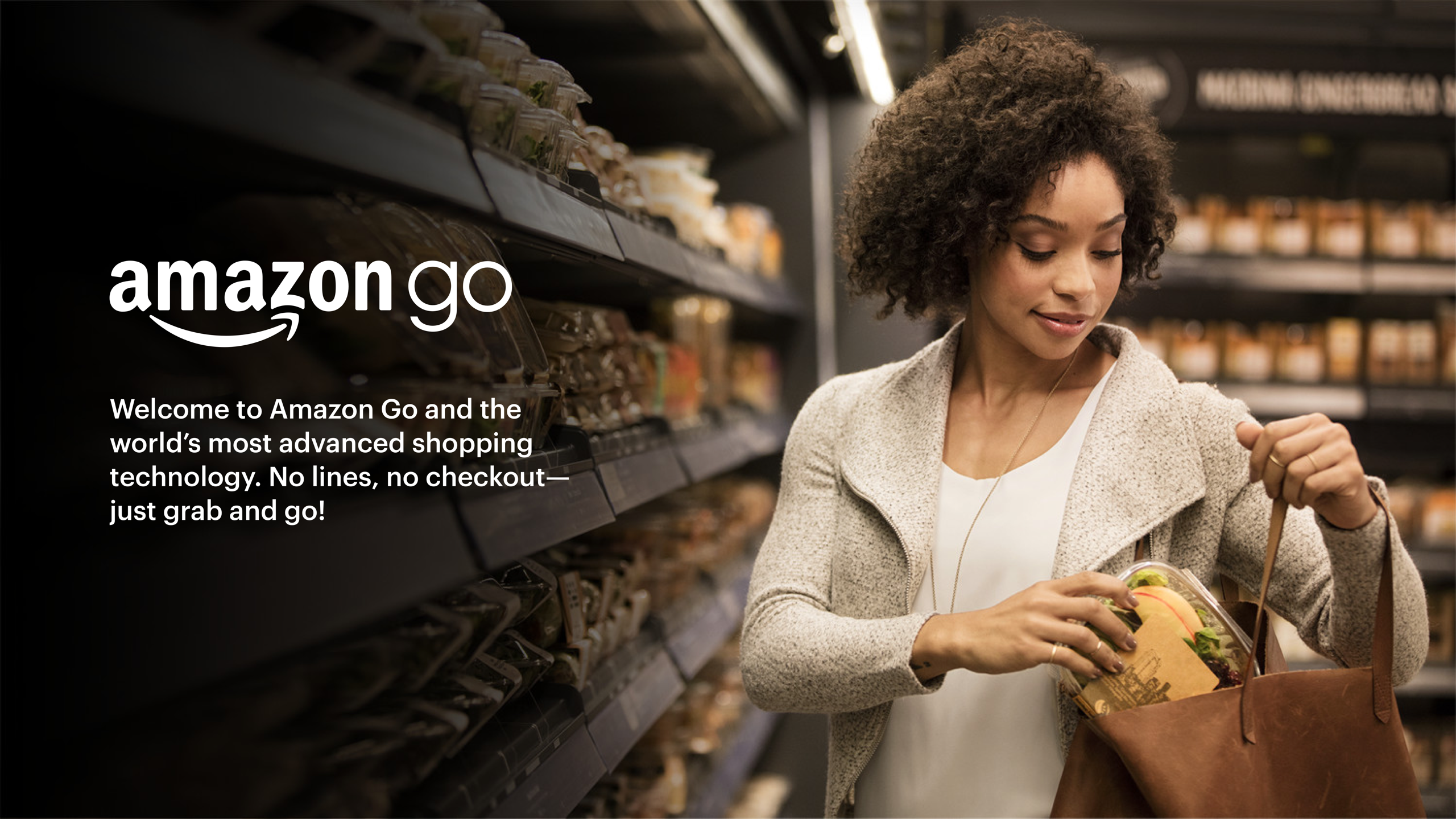
Amazon Go was a cashierless grocery and convenience store concept built on computer vision, sensor fusion, and machine learning. Customers entered with a QR code, picked up what they wanted, and walked out. There was no checkout, cashier, or transaction moment. I was the founding UX designer responsible for making that invisible infrastructure feel trustworthy and legible to both customers and the associates running the store.
The Core Design Challenge
When the transaction moment disappears, so does the primary mechanism customers use to confirm that a system worked correctly. The design challenge was building trust in a system customers could not see, verify in real time, or easily dispute.
The problems I was accountable for solving:
- Customers had no legible model of what the system was tracking or when. Live receipt accuracy lagged behind real-time item detection, creating anxiety during the shopping experience
- Associates needed to detect customer account issues and dietary preferences in the moment, without interrupting the experience
- Human-in-the-loop reviewers needed tooling to spot-check transactions and resolve disputes accurately and efficiently
- The interaction model had to scale across multiple store formats (small convenience, medium grocery, and large-format) without breaking the core trust framework
Design Process
- Research through design: no prior art meant early concepts were hypothesis-driven, tested quickly, and revised in short cycles
- Wizard of Oz UXR: simulated the frictionless experience with humans operating behind the scenes to test customer mental models before the technology was ready
- Shopper observational research: in-store observation of real shopping behavior
- Customer journey mapping: across entry, browse, exit, and post-visit receipt review
- Digital design prototyping: rapid iteration across app flows, kiosk states, and associate tooling
- Store format pivots and explorations: adapted the interaction model across small, medium, and large-format store footprints
- Leadership presentation and roadmap planning: socializing design direction with stakeholders
Key Design Decisions
Set a digital design foundation instead of executing narrowly on individual features
Early pressure was to move fast on individual surfaces. Instead I established a shared foundation that could support parallel workstreams: customer app, associate tooling, back-of-house systems, without each team building independently and incoherently. This cost depth in any single area early on, but it set a higher quality bar across the full experience, scaffolded a shared vision, and created the structure needed to hire and onboard a as the team grew.
Minimize the live in-store receipt in favor of an accurate post-exit receipt
During shopping, item detection lagged slightly behind real-time interaction. An early approach surfaced a live running total in the app. The problem was a receipt that flickered or corrected itself mid-shopping created more anxiety than no receipt at all. The decision was to show a minimal, low-emphasis in-store state and deliver a complete, accurate receipt after exit. Managing expectations honestly built more trust than attempting real-time transparency the system couldn’t yet support reliably.
Make it easy for customers to dispute charges
Dispute tooling was initially scoped as a back-office function. I advocated for surfacing it prominently in the customer-facing receipt experience. The reasoning: customers who can easily flag an error are more likely to trust the system overall, and dispute data directly improves the accuracy of human-in-the-loop review. Friction in dispute flows erodes confidence in the technology.
Outcomes
- Just Walk Out technology scaled to 140+ third-party locations in the U.S., UK, Australia, and Canada. These include travel retailers, sports stadiums, entertainment venues, conference centers, theme parks, convenience stores, hospitals, and college campuses.
- Lumen Field, home of the Seattle Seahawks and Seattle Sounders, reported an 85% increase in transactions and a 112% increase in sales, per game. Lumen Field now has the most Just Walk Out locations of any venue in the world, with nine stores serving more than 68,000 sports fans.
- Delaware North, one of the largest privately-owned hospitality and entertainment companies in the world, has opened more than a dozen stores with Just Walk Out technology at stadiums across the U.S., and these stores serve 20%-30% more customers than traditional concession stands, leading to more revenue and more satisfied fans.
- Market Express at ExCel London, which has 400 events and more than 4 million visitors a year, is now able to serve 300% more customers on their busiest days and has increased annual revenue by 56%.
- Over 18 million items sold in Just Walk Out stores
Source: Amazon News

 Amara Hulslander – Lead AI UX Designer