The Situation
High-consideration purchases on Amazon often create anxiety around affordability. While customers increasingly evaluate total value—not just base price—the Buy Box experience exposes internal feature complexity rather than supporting how customers make decisions. Cost-reducing options like trade-ins, installments, promotions, and warranties are fragmented and inconsistently ordered, forcing customers to reconcile information at the moment of purchase.
The Strategy
I designed a unified Buy Box framework grounded in customer mental models rather than internal program ownership. The framework organizes the experience around core questions customers naturally ask: How much can I spend today?, How do I save money?, and How do I get the most use out of my item?
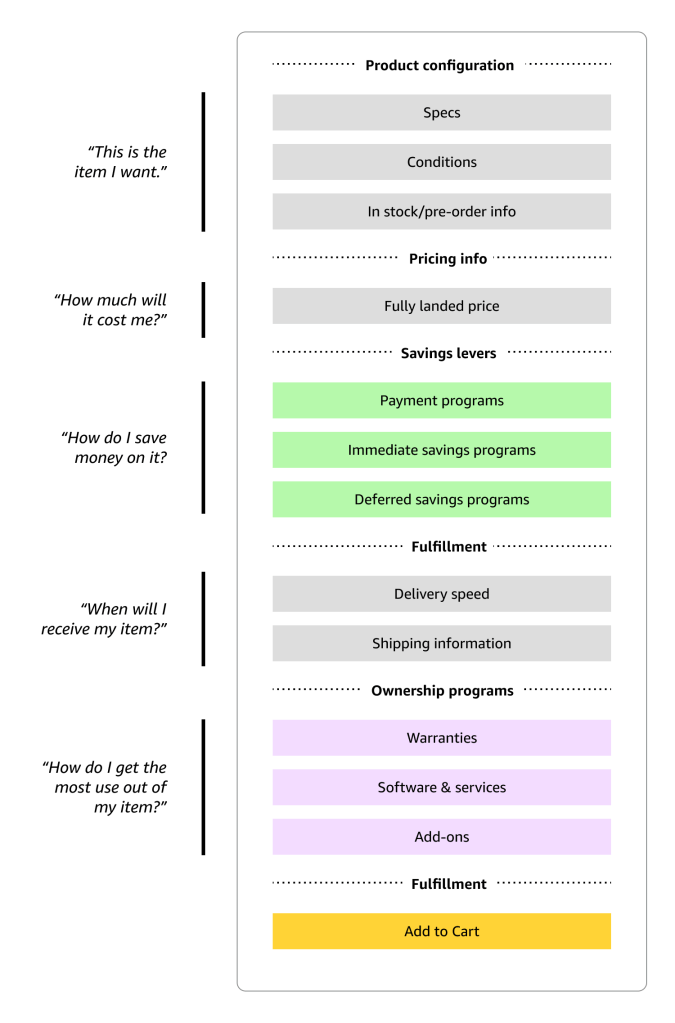
Instead of prescribing a fixed layout, the framework defines macro decision groups—payments, savings, and value adds—with rules for sequencing, prioritization, and suppression. This allowed the experience to flex by product type, acknowledging that expectations differ across categories (for example, trade-ins for wireless versus other high-ASP products).
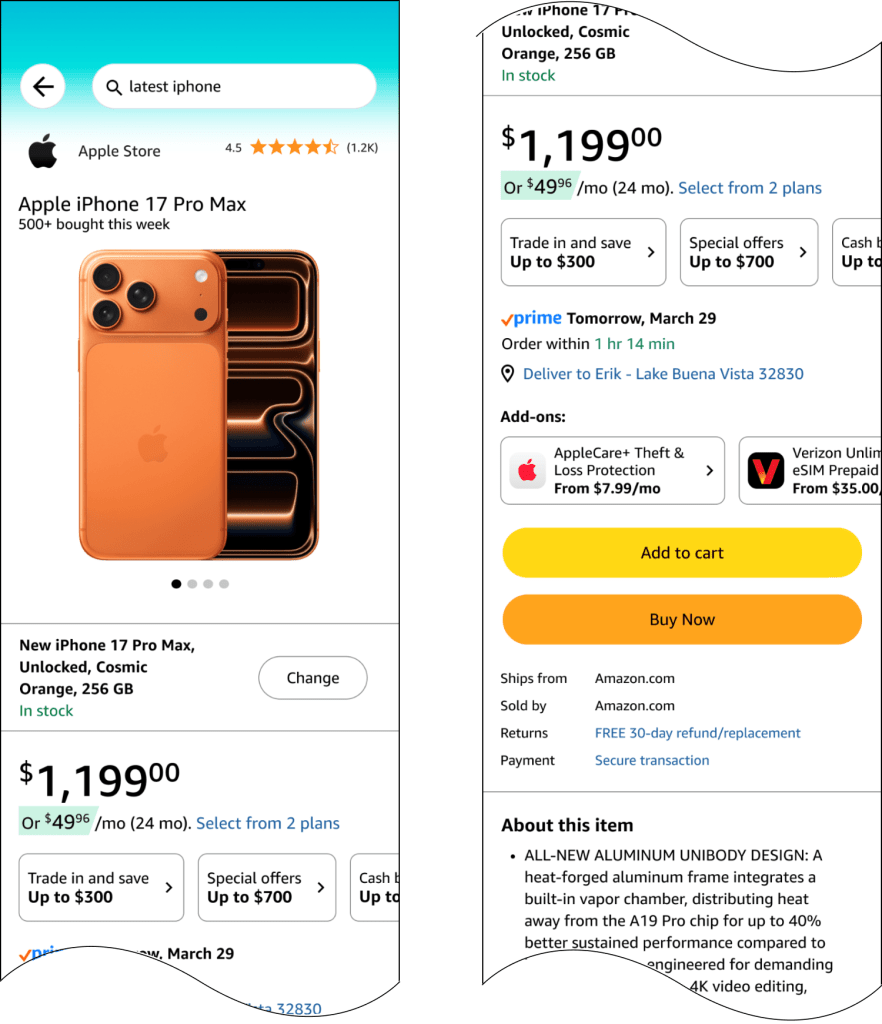
I validated the framework through comparative prototyping and a balanced user study focused on information architecture, feature discovery, and decision flow. The work emphasized pixel frugality and tested whether customers could more quickly understand and act on affordability options when presented as a cohesive system.
The Result
- Prototype preferred 18 of 24 times across trade-in, warranty, and payment scenarios
- Users followed the intended macro-decision sequence, validating the mental model
- Identified clear contextual signals for warranty placement, including preference for wireless warranties above Add to Cart
- Established a scalable Buy Box framework applicable across high-ASP product categories
- Created a foundation for future personalization and contextualization using behavioral and account-level signals

 Amara Hulslander – UX Designer